
Integrating Digital Displays into EV Infrastructure: Building Smarter Charging Experiences

Electric vehicle infrastructure is evolving quickly.
The earliest public charging stations were primarily designed around one objective: deliver electricity safely and reliably to the vehicle.
That remains essential, but the expectations surrounding charging locations are expanding.
Drivers now expect clear charging instructions, intuitive payment guidance, station availability information, account access, navigation support, and a smoother overall experience. Operators, meanwhile, are looking for better ways to communicate with users, manage sites remotely, and create additional value from charging locations.
This is where digital displays are becoming increasingly relevant.
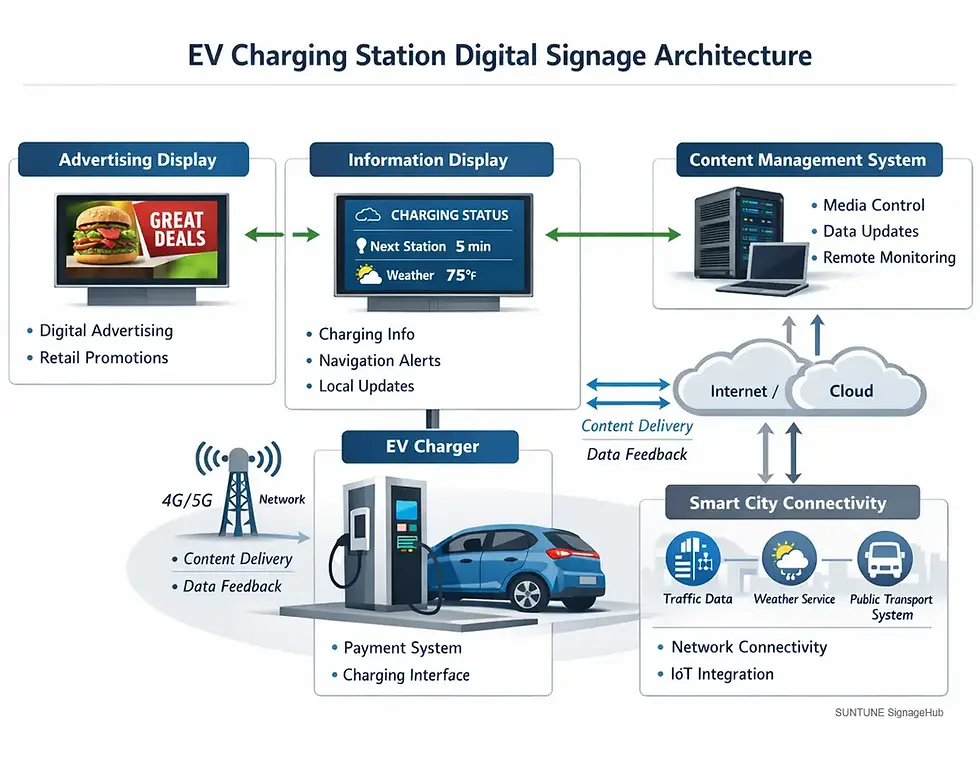
Integrating digital displays into EV infrastructure can transform a charging station from a basic energy point into a connected communication platform.
The display becomes a visible interface between the user, charging hardware, software platform, payment system, advertising network, and surrounding environment.
But successful integration requires much more than mounting a screen beside a charger.
The display must be engineered around the physical, digital, and environmental requirements of the entire charging system.
EV Charging Infrastructure Is Becoming a User Interface
A charging station is not only electrical equipment.
For the driver, it is also an interaction point.
The user needs to understand what to do, whether the charger is available, how charging will begin, how much it may cost, and what happens during the session.
Without clear communication, even technically reliable charging hardware can create a frustrating experience.
A digital display can make that interaction more intuitive.
It can present:
Charging instructions
Session progress
Payment information
Pricing
Vehicle connection status
Estimated charging time
Customer support details
Nearby services
The display effectively becomes the human-facing layer of the charging infrastructure.
That makes visual clarity, responsiveness, and reliability just as important as the information itself.
Why Integration Matters More Than Simply Adding a Screen
A display can be physically attached to a charging station without being meaningfully integrated into the infrastructure.
True integration occurs when the screen becomes part of the charging workflow.
For example, charging status can update automatically based on real-time charger data.
Payment instructions can change according to the user's selected method.
A station fault can trigger an appropriate service message.
Content can be remotely managed from the operator's platform.
This creates a coordinated system rather than separate pieces of hardware.
The value of the display increases significantly when it communicates with the charging ecosystem instead of functioning as an independent advertising screen.
Integration can also reduce confusion because the information shown on the display reflects what is actually happening at the charger.
The Display Can Guide the Entire Charging Journey
The user experience begins before the charging cable is connected.
A digital screen can help guide the driver through each stage of the process.
Before charging, it may communicate connector type, pricing, availability, or payment options.
During the session, the display can show charging progress, elapsed time, estimated completion, or energy delivered.
After charging, it can provide a session summary or instructions for disconnecting safely.
This creates a much more coherent interaction.
A well-integrated display reduces the number of moments when the user has to guess what to do next.
That matters particularly for drivers who are new to EV charging or unfamiliar with a particular charging network.
High Brightness Is Essential for Outdoor Charging Locations
EV charging infrastructure is often installed in open environments.
Parking lots, roadside service areas, retail centers, airports, commercial properties, and highway charging hubs can expose displays directly to sunlight.
A standard indoor LCD may become difficult to read.
Professional outdoor charging displays therefore require sufficient brightness for daytime visibility.
In fully exposed locations, high-brightness LCD technology may need to operate in the range of 2,500 nits or more, depending on environmental conditions and optical design.
However, brightness is only part of the solution.
Anti-glare treatment, reflection control, protective glass, viewing angle, and screen orientation all influence how clearly the user can see the interface.
An EV charging display should be designed around actual outdoor visibility, not simply a high nit specification.
Touch Interaction Adds Another Layer of Engineering
Many EV charging systems use touchscreens because the display is not only showing information—it is accepting user input.
This increases the complexity of the front optical structure.
The touchscreen must remain responsive while also resisting weather, frequent use, and environmental exposure.
Outdoor touch systems may need to consider:
Wet fingers
Rain
Gloves
Temperature extremes
Surface contamination
Repeated public interaction
The protective glass must therefore provide physical durability without reducing touch accuracy or sunlight readability.
Interactive charging displays require the mechanical, optical, and touch systems to work as one integrated front surface.
This is one reason outdoor EV interfaces should not simply reuse components intended for indoor kiosks.
Digital Displays Can Improve Payment Communication
Payment is often one of the most sensitive parts of the charging experience.
Different charging networks may support apps, RFID cards, QR codes, credit card terminals, membership accounts, or other payment methods.
A digital display can help explain these options clearly.
It can also update instructions when a payment method is unavailable or when the charging process requires additional action.
This reduces dependence on small printed labels that can become outdated.
Digital content allows payment guidance to evolve with the charging service without physically modifying the station.
For operators, this creates greater flexibility as payment systems and customer requirements change.
Charging Stations Can Become Media Platforms
EV charging creates an unusual commercial environment.
Drivers often remain near the charging location for several minutes or longer.
This creates an opportunity for relevant digital communication.
Displays can show:
Retail offers
Nearby restaurants
Loyalty programs
Brand campaigns
Local services
EV-related information
Destination guidance
In some locations, commercial content can create an additional revenue stream.
This is particularly relevant at shopping centers, service stations, hotels, entertainment venues, and premium urban locations.
A charging display can serve both an operational role and a media role, provided advertising does not interfere with the charging experience.
The balance is important.
Essential charging information should always remain clear and prioritized.
EV Charging and DOOH Advertising Can Converge
The growth of digital out of home advertising creates another opportunity.
Charging locations can become part of broader DOOH media networks.
A digital display integrated into an EV charging station can potentially participate in remotely managed advertising schedules.
This allows operators to manage commercial content across multiple charging sites.
Location becomes especially important.
A charger positioned at a busy retail destination can attract a different audience from one installed along a highway.
EV charging infrastructure can therefore create new digital media inventory in places where people already stop and spend time.
This does not mean every charging display should become an advertising screen.
But where the business model supports it, the combination can improve the commercial value of the infrastructure.
Smart Content Can Respond to Charging Context
A connected charging display can potentially show content based on what is happening at the station.
If the charger is available, the screen can focus on attracting drivers.
Once a session begins, the display can shift toward charging information.
During longer charging sessions, the system may introduce relevant promotional or informational content.
If a fault occurs, the display can prioritize service instructions.
Context-aware content makes the display more useful because the message changes according to the user's current stage of interaction.
This is much more effective than running the same content continuously.
Remote Content Management Makes Large Networks Practical
A single EV charging station is relatively easy to manage manually.
A network containing hundreds of charging sites is not.
Remote content management allows operators to update displays across multiple locations from a central platform.
Information can be scheduled by region, site, charger type, time, or campaign.
This can help operators maintain consistent branding and communication.
It also allows urgent updates to be distributed quickly.
For example, pricing information, service notices, or payment instructions can be changed without physically visiting each site.
Remote management is what turns individual charging displays into a scalable communication network.
Connectivity Needs to Be Designed for Reliability
A digital display connected to the charging platform depends on communication infrastructure.
This may involve Ethernet, Wi-Fi, cellular connectivity, or another network architecture.
Connectivity interruptions should be considered during system design.
A display should not become unusable simply because the network connection is temporarily interrupted.
Where appropriate, local content storage can allow essential information to continue displaying even if the remote connection is unavailable.
A robust EV display system should distinguish between functions that require live connectivity and functions that must remain available locally.
This helps preserve usability during network disturbances.
Remote Monitoring Supports Better Maintenance
As charging networks grow, maintenance becomes more difficult.
It may not be practical to inspect every display manually.
Remote monitoring can help operators understand what is happening at each site.
Depending on the hardware architecture, operators may be able to monitor:
Display status
Connectivity
Internal temperature
Power conditions
System health
Content playback status
This information can help maintenance teams identify which locations require attention.
Remote monitoring reduces operational blind spots and can help transform maintenance from purely reactive service into more informed infrastructure management.
Outdoor Reliability Must Match Charger Reliability
The display should not become the weakest part of the charging station.
If the charger remains operational but the screen fails, users may still be unable to start the session or understand what is happening.
This makes display reliability particularly important.
Outdoor charging displays need to withstand rain, dust, humidity, UV radiation, heat, cold, and repeated public use.
The enclosure should therefore be engineered around the installation environment.
An appropriate IP protection level, robust materials, weather-resistant seals, thermal management, and protective glass all contribute to long-term performance.
The charging experience is only as reliable as the interface connecting the infrastructure with the user.
Thermal Management Is Especially Important at EV Sites
Charging stations can be installed in environments with strong solar exposure.
The display itself produces heat.
High-brightness backlighting adds more.
The enclosure may absorb solar radiation throughout the day.
This creates a significant thermal load.
A professionally engineered display needs to manage these conditions while maintaining stable image quality and electronic operation.
Depending on the design, thermal management may involve controlled airflow, intelligent fan systems, heat dissipation structures, temperature sensors, or other cooling technologies.
High brightness and thermal management must be designed together.
A screen that is highly visible but frequently overheats does not provide a reliable charging interface.
Smart Brightness Control Can Reduce Energy Waste
EV infrastructure is strongly associated with energy efficiency.
It makes little sense for the digital interface to consume unnecessary energy when the surrounding environment does not require maximum brightness.
Smart brightness control can adjust display luminance according to ambient light.
During intense sunlight, brightness can increase.
During cloudy conditions, evening hours, or nighttime operation, output can decrease.
This helps balance visibility and energy use.
It can also reduce thermal load when maximum brightness is unnecessary.
For EV infrastructure, intelligent brightness control aligns the display with the broader goal of energy-aware system design.
The Physical Integration Matters Too
Digital display integration is not only about software.
The mechanical relationship between the charger and the screen also matters.
Some projects use a display built directly into the charging cabinet.
Others use a separate outdoor kiosk positioned beside the charger.
Each approach has advantages.
Integrated displays can create a compact, unified product.
Separate displays may allow larger screens, easier servicing, or greater flexibility in positioning.
The correct choice depends on:
Screen size
Viewing distance
Installation environment
Maintenance access
Advertising requirements
Charging hardware layout
The display should be positioned where users naturally need information, not simply where there is available mechanical space.
Cable Management and Electrical Architecture Matter
Charging stations already contain significant electrical infrastructure.
Adding a digital display introduces additional power, networking, and control requirements.
Cable routing should be planned carefully.
Power and communication wiring need to be protected from weather and physical damage.
The system architecture should also consider electrical isolation, grounding, surge protection, and service access according to the project requirements.
Good integration hides complexity from the user while keeping the internal system organized and serviceable for technicians.
This becomes increasingly important as more functionality is added to the charging station.
The Display Should Match the Charging Environment
Not every charging site needs the same type of screen.
A charger inside a covered parking garage may require less brightness and environmental protection than a fully exposed roadside installation.
A premium retail location may prioritize appearance and advertising quality.
A highway charging hub may prioritize visibility, reliability, and long-distance wayfinding.
A fleet charging facility may require operational information rather than public advertising.
The correct display architecture depends on the purpose of the charging site.
This is why standardized screen specifications should not replace application-specific engineering.
Wayfinding Can Begin Before the Driver Reaches the Charger
Digital displays can also support navigation around the charging site.
Large charging hubs may contain multiple charger types, parking zones, or service areas.
Freestanding digital signage can direct drivers toward available chargers.
Displays can also communicate:
Charger availability
Parking restrictions
Site maps
Entry and exit routes
Nearby facilities
This is particularly useful at airports, shopping centers, service areas, and large commercial charging hubs.
The digital experience can begin before the charging session itself.
When wayfinding and charging information are coordinated, the entire site becomes easier to use.
EV Displays Can Connect With Smart City Infrastructure
EV charging is increasingly becoming part of larger smart mobility ecosystems.
Charging stations may connect with parking systems, energy platforms, transportation networks, and municipal infrastructure.
Digital displays can become one of the visible interfaces connecting these systems to the public.
For example, a screen could combine charging information with public transportation updates, parking guidance, weather information, or city announcements.
This creates broader value from the same physical infrastructure.
The future EV charging station may function as a connected urban node rather than simply an electrical appliance.
Digital displays can help make that connection visible and useful.
Data Can Improve the Charging Experience
Connected infrastructure produces data.
Charging status, session duration, charger availability, energy delivery, site conditions, and operating status can all generate useful information.
Displays can present selected information directly to users.
Operators can also use system data to improve communication.
If certain instructions repeatedly cause confusion, content can be redesigned.
If users frequently abandon charging at a specific stage, the interface may need improvement.
Digital displays create an opportunity to continuously refine the user experience rather than treating charging instructions as permanent static content.
This is one advantage of combining physical infrastructure with software-driven communication.
Security and System Separation Should Be Considered
As displays become more connected, system architecture becomes more important.
The charging system, payment infrastructure, content management platform, and advertising network may serve different functions.
These systems should be integrated carefully.
A display does not necessarily need unrestricted access to every part of the charging infrastructure.
Good integration connects the systems that need to communicate while maintaining appropriate separation between operational, payment, and content functions.
This supports more manageable and reliable system architecture.
Designing for Serviceability Reduces Lifecycle Cost
EV charging infrastructure is expected to operate for years.
Eventually, displays, media players, power supplies, or cooling components may require maintenance.
The enclosure should therefore support practical service access.
Modular components can simplify replacement.
Clear cable organization can reduce troubleshooting time.
Remote diagnostics can help technicians understand the issue before arriving on site.
Serviceability should be treated as part of the original design rather than something considered only after a component fails.
This can significantly influence the total cost of ownership across a large charging network.
Integrating Digital Displays Into EV Infrastructure Requires a System-Level Approach
The strongest EV charging displays are not designed in isolation.
They are developed around the complete charging environment.
The physical structure, electrical system, software platform, user journey, outdoor conditions, content strategy, and maintenance requirements all influence the final design.
This is why integrating digital displays into EV infrastructure should begin early in project planning.
Adding a screen after the charger architecture has already been finalized can limit placement, service access, thermal design, and connectivity options.
When the display is considered from the beginning, it can become a functional part of the charging system rather than an accessory attached at the end.
The Next Generation of EV Charging Will Be More Visual and Connected
As charging speeds improve, networks expand, and competition increases, the user experience around charging will become more important.
Drivers will expect charging stations to communicate clearly.
Operators will expect better remote management.
Site owners will look for additional commercial value.
Smart cities will increasingly connect EV infrastructure with broader mobility systems.
Digital displays sit at the intersection of all these trends.
They can guide, inform, advertise, interact, and communicate.
But the technology needs to remain reliable under real outdoor conditions.
The future of EV charging is not only about delivering electricity efficiently. It is about creating a connected physical experience around that energy service.
Digital displays will increasingly become part of that experience.
Build Smarter EV Charging Infrastructure with SUNTUNE
SUNTUNE SignageHub develops industrial outdoor LCD display solutions for EV charging stations and smart mobility infrastructure.
Our solutions can be engineered around high-brightness visibility, interactive touch, intelligent brightness control, weather-resistant enclosures, thermal management, remote connectivity, advertising integration, and continuous outdoor operation.
Whether your project involves a single charging kiosk, a retail charging network, highway charging hubs, public infrastructure, or smart city mobility systems, the display should be designed around the complete charging environment.
Contact SUNTUNE SignageHub to discuss your EV infrastructure project and explore an outdoor LCD solution engineered for charging communication, user interaction, digital advertising, and long-term outdoor reliability.


Comments