
Optical Bonding vs Air-Gap Displays: Which Technology Is Better for Outdoor LCD Signage?
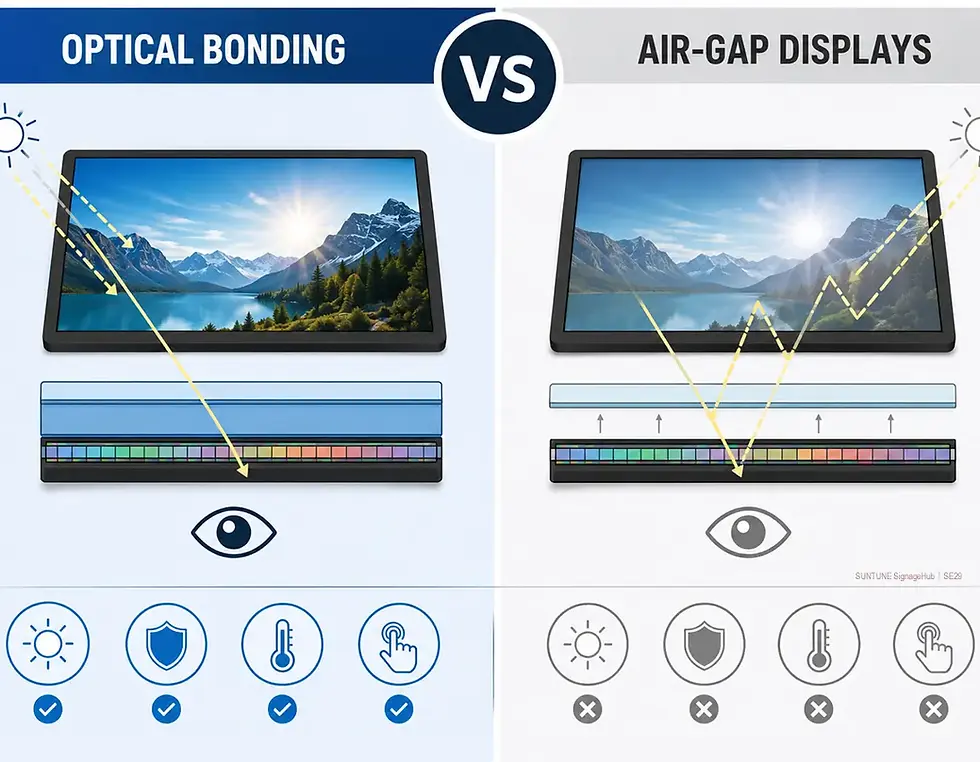
Outdoor digital signage must remain visible and reliable under some of the most demanding environmental conditions. Direct sunlight, moisture, dust, and temperature fluctuations all affect display performance over time. One of the most important engineering decisions behind outdoor LCD systems is the choice between optical bonding and traditional air-gap display structures.
Understanding optical bonding vs air-gap displays helps businesses and integrators select the right technology for long-term outdoor performance, especially in applications where visibility and durability are critical.
What Is an Air-Gap Display?
Traditional LCD displays are commonly built with a small layer of air between the protective cover glass and the LCD panel itself. This design is known as an air-gap display.
Air-gap construction is widely used because it is simpler and generally more cost-effective to manufacture. However, the air layer creates several performance limitations, particularly in outdoor environments.
When light enters the display, reflections occur at multiple surfaces within the air gap. These reflections reduce contrast and make the screen harder to read under bright sunlight. The trapped air space can also become vulnerable to condensation when temperature changes occur.
For indoor applications, these issues may be manageable. In outdoor environments, they become much more significant.
What Is Optical Bonding?
Optical bonding is an advanced display technology that removes the air gap between the cover glass and LCD panel. Instead, a transparent optical-grade adhesive fills the space completely.
This bonded structure dramatically improves display performance by reducing internal reflections and increasing light transmission.
As a result, displays become easier to read in direct sunlight while also gaining additional structural and environmental protection.
The comparison of optical bonding vs air-gap displays often becomes especially important for outdoor digital signage, transportation systems, industrial equipment, and interactive kiosks.
Visibility and Sunlight Readability
One of the biggest advantages of optical bonding is improved visibility.
Air-gap displays lose a portion of light through internal reflections. Under strong sunlight, this reflected light washes out the image and reduces readability.
Optical bonding minimizes these reflections, allowing more light to pass directly through the display. This improves contrast, color clarity, and perceived brightness.
In many outdoor deployments, optical bonding can achieve better visibility without requiring excessive brightness increases, which also helps reduce thermal stress and energy consumption.
For sunlight-readable applications, the difference in optical bonding vs air-gap displays is often immediately noticeable.
Thermal Performance and Heat Management
Thermal management is another critical difference between these technologies.
Outdoor displays generate internal heat from high-brightness backlights while also absorbing external heat from sunlight. Air gaps can trap heat unevenly within the display structure, potentially creating thermal stress points.
Optical bonding improves thermal transfer across the display layers, helping heat dissipate more evenly. This contributes to greater thermal stability and reduces the risk of overheating-related issues such as LCD blackening.
Because outdoor LCD reliability is closely tied to temperature control, optical bonding has become increasingly valuable in harsh environments.
Durability and Environmental Protection
Durability is one of the strongest arguments in favor of optical bonding for outdoor use.
The air layer inside traditional displays creates an opportunity for moisture intrusion and condensation. In humid or rapidly changing environments, condensation inside the display can affect image quality and long-term reliability.
Optical bonding eliminates this internal air space, significantly reducing the risk of internal fogging and moisture-related failures.
The bonded structure also increases mechanical strength. The display becomes more resistant to vibration, shock, and physical stress, which is especially important in transportation hubs, industrial sites, and public infrastructure.
Touchscreen Performance
Touch responsiveness is another area where optical bonding offers advantages.
Because the bonded layers are physically connected without an air gap, touch input feels more direct and accurate. Users experience less visual separation between the glass surface and displayed content.
This creates a smoother and more premium interactive experience, especially for outdoor kiosks and wayfinding systems.
In modern outdoor touchscreen systems, optical bonding is often paired with advanced touch technologies to maximize responsiveness under difficult environmental conditions.
Cost Considerations
Despite its advantages, optical bonding is more complex and expensive to manufacture compared to air-gap displays.
The process requires precise alignment, specialized adhesives, and strict contamination control during production. These additional manufacturing requirements increase overall system cost.
However, many businesses find that the improved reliability, visibility, and reduced maintenance justify the investment over the product lifecycle.
When evaluating optical bonding vs air-gap displays, the decision often comes down to balancing upfront cost against long-term operational value.
Which Technology Is Better for Outdoor Displays?
For basic indoor or low-demand applications, air-gap displays may still provide a cost-effective solution.
However, for outdoor digital signage operating under direct sunlight, temperature fluctuations, and continuous public use, optical bonding offers significant performance advantages.
The combination of improved readability, stronger durability, better thermal behavior, and enhanced touch performance makes optical bonding the preferred choice for many professional outdoor display systems.
As outdoor environments become more demanding, the industry continues moving toward bonded display technologies for higher reliability and longer product lifespan.
Outlook for Outdoor Display Engineering
As digital signage technology advances, optical bonding will likely become increasingly common across outdoor applications. Improvements in adhesive materials, manufacturing precision, and thermal engineering are continuing to enhance display performance while reducing production complexity.
Future outdoor LCD systems will rely even more heavily on integrated optical and thermal engineering to meet growing expectations for visibility, durability, and energy efficiency.
For businesses investing in long-term digital signage infrastructure, understanding optical bonding vs air-gap displays is becoming an essential part of making informed technology decisions.
Explore Professional Outdoor Digital Signage Solutions
Looking for outdoor display solutions built for visibility, durability, and long-term reliability?
Our outdoor LCD systems are engineered with advanced display technologies designed for demanding environments, including high-brightness performance, thermal management, and optical enhancement solutions.
👉 Contact us today to discuss your outdoor digital signage project or request a customized solution for your application.


Comments