
Anti-Glare Technologies for Outdoor LCD Screens: Improving Sunlight Readability

Outdoor LCD displays face an optical problem that indoor screens rarely encounter at the same intensity: the display must compete not only with ambient light, but also with reflections from the light itself.
A screen can produce thousands of nits and still become difficult to read when direct sunlight reflects from its front surface. Dark areas lose contrast, colors appear washed out, and text becomes harder to distinguish.
This is why professional outdoor LCD engineering cannot rely on brightness alone.
Anti-glare technology is an important part of making an outdoor display genuinely sunlight readable. It works alongside high-brightness LCD panels, optical treatments, protective glass, enclosure design, and thermal management to create a display that remains usable in challenging daylight conditions.
For transportation systems, smart cities, EV charging stations, outdoor kiosks, roadside advertising, and other exposed applications, understanding the difference between brightness, anti-glare, and anti-reflective technologies is essential when selecting the right display.
Why Sunlight Creates Glare on Outdoor LCD Screens
Every display produces light from behind its front surface. At the same time, sunlight and other ambient light can strike the surface from outside.
Some of that external light is reflected toward the viewer.
The result is a mixture of two optical signals: the image generated by the LCD and unwanted reflected environmental light.
When the reflected light becomes strong enough, it reduces the perceived difference between bright and dark areas of the image.
This is why a screen can technically be operating at full brightness while still appearing difficult to read.
The problem is not always insufficient screen brightness. Sometimes the problem is excessive reflected light.
Brightness and Glare Are Two Different Problems
One of the most common misconceptions about outdoor digital signage is that increasing brightness automatically solves sunlight readability.
It helps, but only to a point.
Consider a high-brightness LCD operating at 2,500 nits. If sunlight creates strong reflections across the front glass, some of the visual information produced by the LCD can still be obscured.
Increasing brightness further may improve the situation, but it can also increase power consumption and heat generation.
A more effective engineering strategy is to address both sides of the equation:
Increase useful light from the display while reducing unwanted reflected light.
This is where anti-glare and anti-reflective technologies become important.
What Is Anti-Glare Technology?
Anti-glare technology is designed primarily to reduce the visual impact of reflections and bright glare on the display surface.
One common approach involves modifying the surface of the glass or coating to scatter reflected light rather than allowing it to form sharp mirror-like reflections.
Instead of seeing a strong reflection of the sun, a building, or surrounding objects, the reflected light is distributed across a wider area.
This can make the image more comfortable to view under bright conditions.
However, there is an important trade-off.
Too much surface diffusion can reduce image sharpness or perceived contrast.
Therefore, professional outdoor displays need to balance glare reduction with optical clarity.
What Is Anti-Reflective Technology?
Anti-reflective technology takes a different approach.
Rather than primarily scattering reflected light, an anti-reflective treatment is designed to reduce the amount of light reflected from the surface in the first place.
Specialized optical coatings can reduce surface reflection through controlled interaction between light waves and coating layers.
The result can be improved contrast and visibility under strong ambient lighting.
Anti-reflective solutions are particularly useful when preserving image clarity and sharpness is important.
Anti-glare and anti-reflective technologies are related, but they are not identical.
The optimal choice depends on the display design, application, viewing environment, and desired optical performance.
Anti-Glare vs. Anti-Reflective: What's the Difference?
The terms are sometimes used interchangeably in marketing, but they describe different optical strategies.
An anti-glare surface generally works by diffusing reflected light, reducing the intensity of visible glare.
An anti-reflective treatment aims to reduce reflection itself, allowing more of the display's emitted light to reach the viewer.
Neither approach is universally superior.
For some outdoor applications, glare diffusion may provide the desired viewing experience. For high-end transportation displays, detailed wayfinding systems, or applications requiring sharp text, reducing reflection while preserving optical clarity may be more important.
The right solution should be selected according to the actual visual requirements of the installation rather than the terminology used on a specification sheet.
Protective Glass Also Affects Outdoor Visibility
Outdoor LCD displays often require protective front glass because they operate in public and exposed environments.
However, adding another optical layer in front of the LCD can change how light behaves.
The glass may introduce additional reflection if its surface is not appropriately treated.
This is why protective glass should not be considered independently from the display's optical system.
Its thickness, surface treatment, transmission characteristics, and integration with the LCD panel can all influence final visibility.
A strong outdoor display design treats protective glass as part of the optical system, not simply as a physical shield.
Optical Bonding Can Improve Outdoor Display Performance
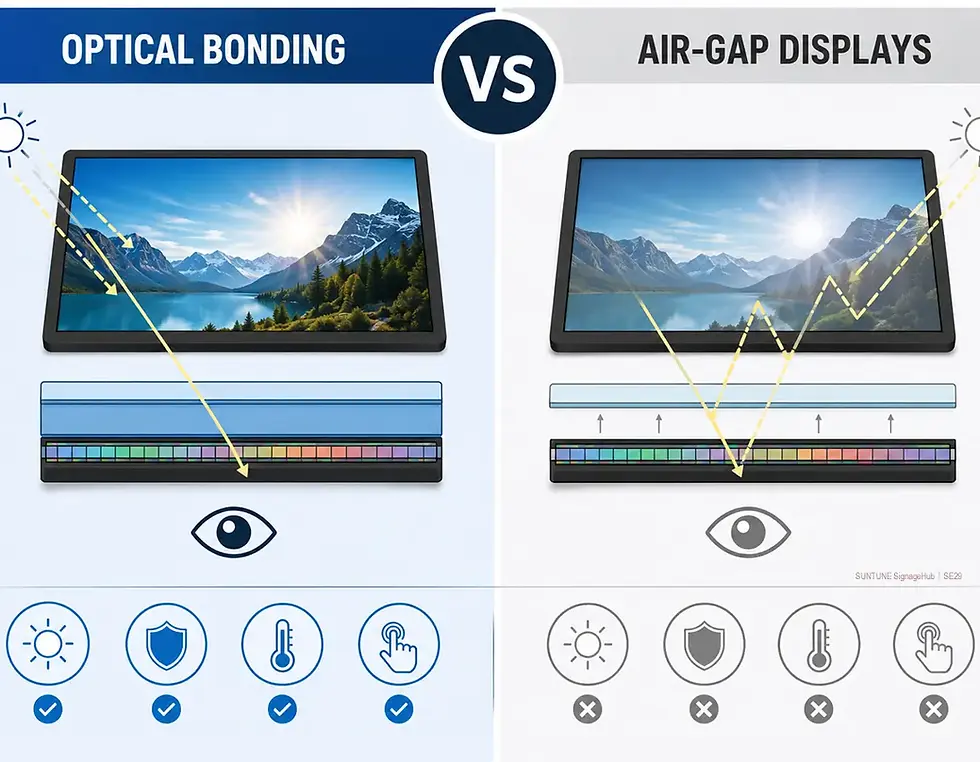
Optical bonding is another technology that can influence sunlight readability.
In a conventional display structure, there may be an air gap between the LCD panel and the protective glass or touch layer.
That air gap can create additional interfaces where light is reflected.
Optical bonding fills the space between layers with an optically compatible bonding material, reducing internal reflections.
It can also improve perceived contrast and reduce the visual effects associated with internal reflections.
For outdoor applications, optical bonding may provide additional benefits related to durability and touch performance, depending on the design.
Reducing internal reflection can be just as important as controlling reflection from the outermost surface.
Why High Brightness and Anti-Glare Should Work Together
A professional outdoor LCD is rarely dependent on one optical technology.
High brightness provides the display with enough emitted light to compete with strong ambient illumination.
Anti-glare treatments reduce the visual impact of reflected light.
Anti-reflective technologies can further reduce surface reflection.
Optical bonding can minimize reflections between internal layers.
Protective glass provides physical protection while being carefully integrated into the optical system.
Together, these technologies create a much stronger sunlight-readable solution.
Outdoor visibility is the result of optical system engineering, not simply a high nit number.
The Importance of Contrast in Direct Sunlight
Brightness is easy to measure, but perceived readability is more complicated.
When sunlight reflects from a display surface, black areas can appear lighter. This reduces the perceived contrast between dark and bright elements.
For advertising content with large graphics, the effect may be manageable.
For transportation schedules, maps, navigation information, and small text, reduced contrast can have a much greater impact.
This is why outdoor display design should consider contrast under actual ambient lighting, rather than relying only on the maximum luminance specification.
A display with excellent contrast and controlled reflection may provide a better viewing experience than a significantly brighter screen with excessive surface reflection.
Screen Orientation Changes Glare Performance
The position of the display relative to the sun can have a significant effect on reflections.
A vertically mounted screen may receive direct sunlight at certain times of the day. A screen tilted at a different angle may reduce the amount of sunlight reflected toward the viewer.
The surrounding environment also matters.
Nearby glass buildings, vehicles, pavement, and other reflective surfaces can redirect sunlight toward the display.
Therefore, the optical design should be considered together with the physical installation.
Display orientation, viewing angle, and local surroundings can materially influence the effectiveness of an anti-glare solution.
High Brightness Creates a Thermal Challenge
There is another reason not to rely exclusively on increasing brightness.
Higher luminance typically requires more powerful backlighting. More electrical power means more heat.
At the same time, the display may already be receiving substantial thermal energy from direct sunlight.
This creates a difficult operating condition for the enclosure.
Professional outdoor displays therefore need appropriate thermal management to maintain stable internal temperatures while delivering the required brightness.
Intelligent cooling can adjust performance according to internal temperature and environmental conditions.
Optical performance and thermal engineering must be developed together when designing high-brightness outdoor LCD displays.
Anti-Glare Technology Has Trade-Offs
There is no optical treatment that improves every characteristic simultaneously.
A highly diffusive surface can reduce sharp reflections but may introduce a slightly hazier appearance.
A highly polished surface may preserve image sharpness but produce stronger reflections.
Anti-reflective coatings can improve transmission and reduce reflection but may introduce additional manufacturing complexity and cost.
Protective glass adds durability but can create another optical interface.
The goal is therefore not to eliminate every reflection under every condition.
The goal is to achieve the best practical balance between glare reduction, image clarity, contrast, durability, and cost for the intended application.
How to Evaluate an Outdoor LCD for Sunlight Readability
When comparing outdoor displays, buyers should look beyond the brightness specification.
A useful evaluation should consider:
Brightness: Is the panel sufficiently bright for the worst realistic daylight conditions?
Surface treatment: Does the display use anti-glare, anti-reflective, or another optical treatment?
Protective glass: How does the glass affect reflection and light transmission?
Contrast: Does the display maintain clear differentiation between dark and bright content?
Viewing angle: Can users read the information from the intended positions?
Thermal management: Can the display maintain stable operation at high brightness?
Installation orientation: How will sunlight interact with the screen throughout the day?
A complete optical evaluation is much more informative than comparing nits alone.
Why Outdoor Applications Require More Than Indoor Display Technology
Indoor displays benefit from controlled lighting conditions.
Outdoor displays do not.
They may need to operate under direct sunlight at midday, overcast conditions in the afternoon, and darkness at night. They may also face rain, dust, humidity, temperature extremes, and continuous operation.
This means an outdoor LCD needs to be designed as an integrated system.
High-brightness LCD technology, anti-glare treatment, thermal management, protective glass, enclosure protection, and intelligent brightness control all need to work together.
Adapting an indoor monitor for outdoor use is fundamentally different from engineering a display specifically for outdoor conditions.
Applications Where Anti-Glare Performance Matters Most
Some outdoor applications have particularly demanding readability requirements.
Transportation displays are a good example because passengers may need to read relatively small text while standing at different angles and distances.
EV charging displays require users to interpret charging information and interact with the interface while exposed to daylight.
Smart city kiosks may present maps, public information, and interactive services.
Roadside advertising displays need strong visual impact while competing with intense ambient light.
Retail window displays face another challenge: sunlight can enter through surrounding glass and create reflections on the screen.
Across all these applications, controlling reflected light can be just as important as increasing display brightness.
The Future of Outdoor Optical Engineering
Outdoor digital signage is becoming larger, brighter, and more interactive.
At the same time, users expect better readability and more natural visual quality.
This is driving continued development in optical coatings, protective glass, bonding materials, panel technology, and intelligent brightness control.
Future outdoor displays will increasingly combine these technologies rather than depending on one solution.
The result will be displays that can adapt their brightness to changing environmental conditions while maintaining controlled reflection and high contrast.
The future of sunlight-readable outdoor LCD technology is not simply brighter screens. It is smarter optical engineering.
Choosing the Right Anti-Glare Solution
When selecting an outdoor LCD, the question should not simply be, "Does it have anti-glare?"
A better question is: How has the complete optical system been designed for the actual sunlight conditions of the installation?
The answer should consider brightness, reflection, protective glass, optical bonding, contrast, viewing angle, screen orientation, and thermal management.
For demanding applications, it is also valuable to evaluate the display under realistic lighting conditions rather than relying entirely on laboratory specifications.
A well-engineered outdoor LCD should be designed around how people will actually see and use the screen—not just how the screen performs on a specification sheet.
Engineering Better Sunlight Readability with SUNTUNE
SUNTUNE SignageHub develops high-brightness outdoor LCD display solutions for transportation, smart cities, EV charging stations, outdoor advertising, retail, and other demanding applications.
Our engineering approach considers the complete outdoor display system, including brightness, anti-glare performance, optical design, protective glass, thermal management, enclosure protection, and long-term reliability.
If your project requires clear information in direct sunlight, our team can help evaluate the appropriate brightness and optical configuration rather than simply recommending the highest available specification.
Contact SUNTUNE SignageHub to discuss your anti glare outdoor LCD screens and develop a sunlight-readable digital signage solution engineered for your real installation environment.


Comments