
COF Cable Issue Repair for Outdoor LCD Displays: Causes, Symptoms, and Professional Solutions
- May 26
- 4 min read
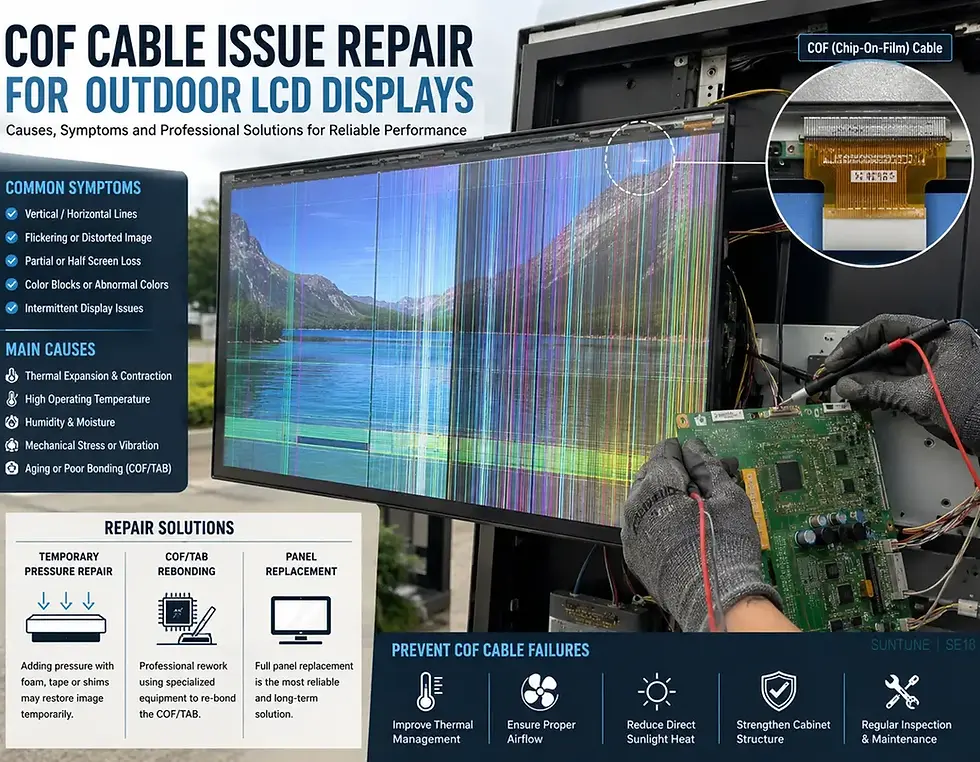
Outdoor LCD displays are designed to operate under demanding environmental conditions including direct sunlight, heat, humidity, dust, and continuous 24/7 usage. While commercial outdoor displays are engineered for durability, one of the most difficult panel-level problems remains the COF cable issue.
Understanding COF cable issue repair for outdoor LCD displays is important for manufacturers, integrators, maintenance teams, and digital signage operators seeking long-term reliability and reduced downtime.
What Is a COF Cable?
COF stands for Chip-On-Film, a flexible circuit technology used to connect LCD driver ICs directly to the display glass substrate. These ultra-fine bonded cables transfer image data and timing signals from the T-CON board to the LCD panel.
In modern IPS displays, especially large-format outdoor LCD screens such as 55”, 65”, 75”, and 86” models, COF technology allows slim bezels and high-resolution image processing. However, because the bonding area is extremely delicate, COF assemblies are also vulnerable to mechanical stress and thermal expansion.
Common Symptoms of COF Failure
A failing COF cable may produce several visible display abnormalities, including:
Vertical colored lines
Horizontal lines across the screen
Partial image loss
Half-screen blackouts
Flickering image sections
Ghosting or unstable refresh
Random color blocks
Intermittent image recovery after pressing the panel edge
In many cases, the issue appears intermittently during the early stage before becoming permanent over time.
Why Outdoor LCD Displays Experience More COF Failures
Outdoor digital signage environments are significantly harsher than indoor applications. Large-format high-brightness IPS displays generate substantial heat internally, while direct solar radiation increases panel surface temperatures even further.
Several factors contribute to COF degradation in outdoor displays:
Continuous High Temperature
High-brightness backlight systems produce considerable thermal load. If heat dissipation is uneven, localized hotspots can weaken COF bonding over time.
Thermal Expansion and Contraction
Outdoor environments experience daily temperature fluctuations. Repeated expansion and contraction place stress on the bonded connection between the film cable and panel glass.
Mechanical Chassis Stress
Improper installation, transportation vibration, or enclosure flex can slightly deform the panel structure. Even minimal torsion can affect delicate COF bond areas.
Humidity and Moisture Exposure
Although outdoor displays use weatherproof enclosures, long-term humidity exposure may still accelerate corrosion around sensitive electronic areas.
24/7 Operating Conditions
Commercial outdoor signage often runs continuously. Extended operating hours increase thermal fatigue and gradually reduce bonding reliability.
How Technicians Diagnose a COF Cable Issue
Diagnosing a true COF failure requires careful isolation from other possible causes such as:
T-CON board failure
LVDS or eDP cable issues
Power supply instability
Mainboard malfunction
Driver board defects
A common diagnostic method involves applying gentle pressure near the suspected COF bonding area. If the image temporarily changes or recovers, the issue is often related to the COF bond itself.
Temperature-based behavior is also common. Some displays perform normally when cold but develop lines or flickering after warming up.
COF Cable Issue Repair Methods
1. Temporary Pressure Repair
Some technicians attempt temporary stabilization using foam pads, thermal tape, or pressure shims to reinforce weak bonding points.
While this method may restore the image temporarily, it is generally not reliable for commercial outdoor signage deployments due to ongoing thermal stress.
2. Professional TAB or COF Rebonding
Specialized LCD repair facilities may perform TAB bonding or COF rebonding using advanced alignment equipment and anisotropic conductive film (ACF).
This process may involve:
Removing the defective COF
Cleaning the bonding area
Installing a replacement film
Heat-press bonding with precision equipment
However, large-format IPS panels require extremely accurate alignment, and repair success rates can vary depending on panel condition.
3. Full LCD Panel Replacement
For many outdoor signage projects, replacing the LCD panel module is the most stable long-term solution.
This approach allows integrators to reuse:
Outdoor enclosure
Cooling system
Power supply
Android or OPS system
Control electronics
while restoring overall display reliability.
Preventing COF Failures in Outdoor Digital Signage
Prevention is often more cost-effective than repair. Outdoor display manufacturers and integrators should focus heavily on thermal management and structural stability.
Recommended practices include:
Improve Cooling Efficiency
Uniform airflow design helps reduce localized thermal stress on panel edges and driver IC areas.
Minimize Direct Solar Heat Gain
Using high-efficiency optical bonding, anti-reflective glass, and thermal insulation can help lower internal operating temperatures.
Reduce Chassis Flex
Large-format outdoor displays should use rigid cabinet structures and proper mounting methods to minimize torsion.
Use Commercial-Grade Components
Commercial-grade IPS panels and industrial thermal systems typically provide higher long-term stability under outdoor operating conditions.
Perform Preventive Maintenance
Routine inspection of cooling fans, filters, internal humidity levels, and thermal performance can help identify early warning signs before major failures occur.
The Importance of Reliable Outdoor Display Engineering
As outdoor digital signage networks continue expanding across transportation hubs, smart cities, retail environments, drive-thru systems, and public information applications, display reliability becomes increasingly important.
Professional manufacturers such as SUNTUNE continuously focus on improving thermal control, structural durability, and long-term operational stability in high-brightness outdoor LCD displays to reduce the risks associated with panel-level failures including COF degradation.
Final Thoughts
COF cable issues are among the most technically challenging failures in outdoor LCD displays. Because COF assemblies directly connect critical driver circuits to the panel glass, repair complexity is significantly higher than standard electronic board replacement.
Understanding the causes, symptoms, and repair limitations of COF cable issue repair for outdoor LCD displays helps operators make better maintenance decisions, reduce downtime, and extend the lifespan of commercial digital signage systems.
As outdoor display technology evolves, better thermal engineering, panel protection, and industrial-grade design will continue playing a major role in minimizing COF-related failures in the future.


Comments