
Interactive Outdoor Displays and Urban Experiences: How Smart Cities Are Transforming Public Spaces

Cities are becoming increasingly connected through digital infrastructure. Beyond roads, transportation systems, and communication networks, modern urban environments now rely on intelligent visual communication to deliver information where people need it most. This evolution has made interactive outdoor displays and urban experiences closely connected, transforming digital signage from passive advertising into an active component of everyday city life.
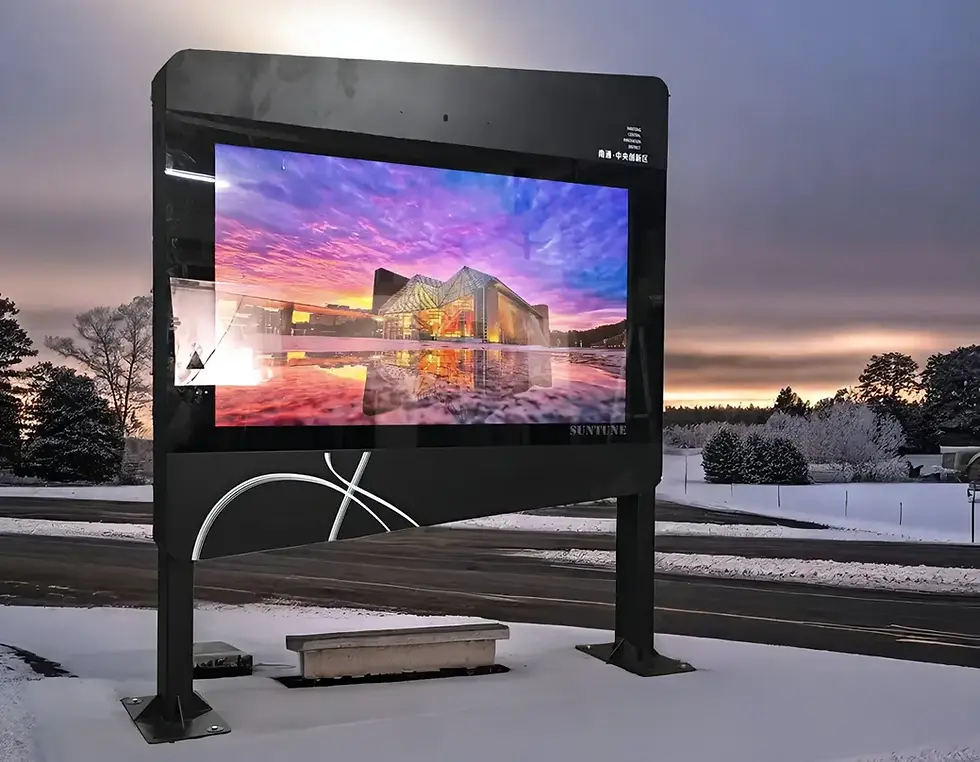
Today, outdoor LCD displays serve as public communication platforms that help residents, commuters, and visitors navigate complex urban environments while improving accessibility, safety, and operational efficiency.
From Digital Signage to Interactive Urban Infrastructure
Traditional outdoor displays primarily broadcast advertisements or public announcements. While these applications remain important, today's interactive systems perform a much broader role.
Outdoor kiosks now provide real-time transportation schedules, digital maps, emergency notifications, event information, municipal services, and local business directories. Citizens can interact directly with these systems, creating a two-way communication channel rather than simply receiving information.
This transformation reflects a broader shift toward interactive public infrastructure, where digital displays become valuable service points throughout the city.
Creating Better Urban Experiences Through Interaction
The success of a smart city depends on how easily people can access information.
Interactive outdoor displays improve the urban experience by reducing uncertainty and helping users make informed decisions in real time. A visitor searching for public transportation, a tourist locating nearby attractions, or a resident looking for municipal services can all receive immediate assistance through a single interface.
Rather than simply displaying content, these systems create meaningful interactions between technology and people, making cities more intuitive and accessible.
Outdoor LCD Technology Enables Reliable Public Service
Urban environments place extraordinary demands on display hardware. Systems must remain operational through direct sunlight, heavy rain, dust, humidity, and significant temperature variations.
This is why interactive outdoor displays and urban experiences depend heavily on industrial-grade outdoor LCD technology.
High-brightness displays maintain readability during daylight hours, while rugged enclosure engineering protects sensitive electronics from environmental exposure. Intelligent thermal management ensures stable operation throughout seasonal temperature changes, allowing kiosks to provide uninterrupted public services.
Without reliable hardware, even the most advanced software platform cannot deliver a consistent user experience.
Connectivity Is the Foundation of Smart Cities
Modern interactive displays rarely operate independently.
Instead, they are integrated into cloud-based management platforms that distribute content, monitor device health, collect operational statistics, and update information instantly across entire city networks.
Transportation authorities can publish service updates within seconds. Emergency management agencies can broadcast urgent alerts immediately. Municipal departments can coordinate citywide communication from centralized platforms.
This level of integration creates connected urban ecosystems, where information flows efficiently between infrastructure and the public.
Human-Centered Design Improves Accessibility
Technology should simplify public life rather than complicate it.
Successful interactive outdoor displays prioritize intuitive interface design, multilingual support, accessible navigation, and responsive touch interaction. Displays are increasingly designed to accommodate users of different ages, languages, and physical abilities.
Accessibility is becoming an essential engineering consideration rather than an optional feature.
By placing user experience at the center of system design, cities create more inclusive public environments while improving citizen satisfaction.
Data Intelligence Supports Smarter Decision Making
Interactive outdoor displays also generate valuable operational insights.
Anonymous usage statistics help municipalities understand pedestrian traffic patterns, popular destinations, peak operating hours, and service demand. This information supports better planning for transportation, tourism, public safety, and commercial development.
As display networks expand, data-driven decision making will become an increasingly important advantage for smart city operators.
Engineering Reliability Determines Long-Term Success
Although software attracts significant attention, hardware reliability ultimately determines system availability.
Outdoor interactive displays require carefully engineered enclosure systems, efficient cooling strategies, durable touch technologies, vandal-resistant glass, corrosion-resistant materials, and modular maintenance access.
Each engineering decision contributes to system uptime, maintenance efficiency, and total cost of ownership throughout the product lifecycle.
In large-scale deployments, engineering reliability becomes the foundation upon which every digital service depends.
Looking Ahead: The Future of Interactive Urban Experiences
The next generation of outdoor interactive displays will extend far beyond digital directories and information kiosks.
Artificial intelligence will enable personalized public information. Computer vision may support adaptive user interfaces. IoT integration will allow displays to communicate directly with transportation systems, environmental sensors, and municipal infrastructure. Edge computing will reduce response times while improving operational efficiency.
Future smart cities will increasingly rely on interactive outdoor displays as intelligent communication hubs that connect people, infrastructure, and digital services in real time.
The evolution of interactive outdoor displays and urban experiences represents more than technological progress. It reflects a broader transformation toward cities that are more connected, responsive, accessible, and efficient. As urban populations continue to grow, interactive outdoor LCD technology will remain one of the most visible and valuable components supporting the future of intelligent public infrastructure.
Build Interactive Smart City Solutions with SUNTUNE
Whether you're planning a smart city deployment, digital wayfinding project, transportation information network, or interactive public kiosk system, selecting the right outdoor display technology is essential for long-term performance.
At SUNTUNE SignageHub, we design and manufacture industrial-grade outdoor LCD displays engineered for high brightness, environmental protection, intelligent thermal management, and continuous public operation. Our OEM and ODM capabilities help system integrators, distributors, and project developers deploy reliable digital signage solutions for modern urban environments.
Contact SUNTUNE SignageHub today to discuss your project requirements and discover how our outdoor LCD technologies can help create smarter, more connected urban experiences.


Comments