
Outdoor Interactive Displays: The Next Generation of Smart Digital Signage

Digital signage has traditionally been a one-way communication medium. A screen displays information, advertisements, directions, or announcements, while people simply watch.
That relationship is changing.
Today's outdoor digital displays are increasingly becoming interactive platforms where people can search for information, explore locations, make selections, access services, complete transactions, and communicate with connected systems.
From touchscreen wayfinding kiosks in city centers to self-service terminals at EV charging stations, the role of outdoor displays is expanding beyond visual communication.
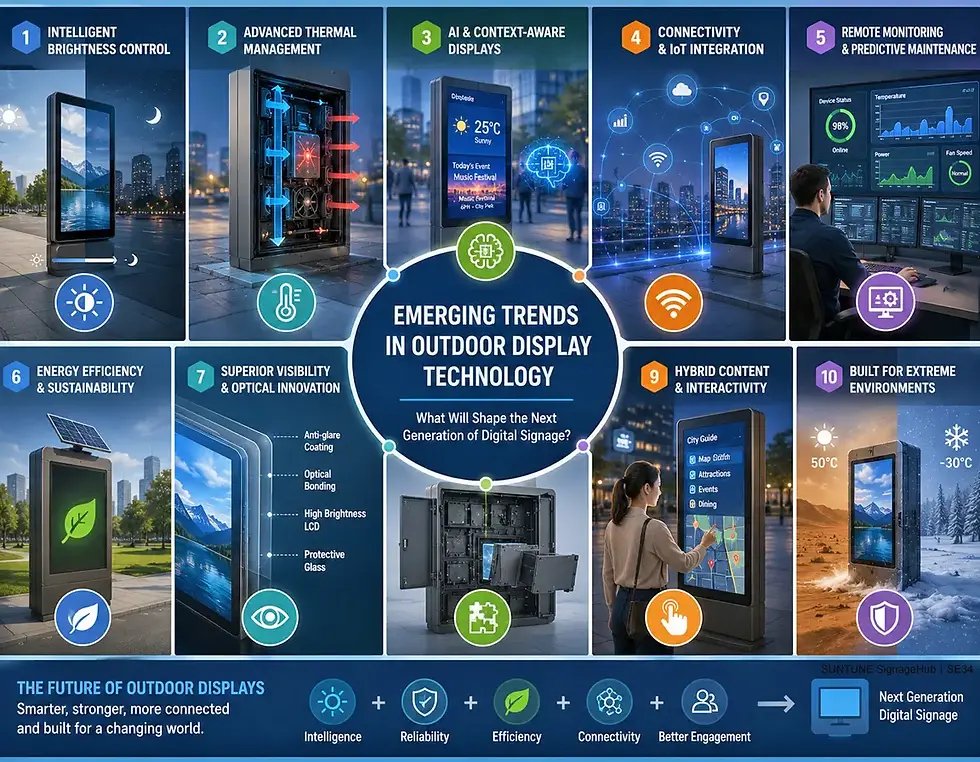
The next generation of outdoor interactive displays will combine high-brightness LCD technology, intelligent software, real-time connectivity, AI-assisted interfaces, and increasingly sophisticated environmental engineering.
But there is an important distinction between an interactive display that works in a controlled indoor environment and one expected to operate reliably in direct sunlight, rain, dust, extreme temperatures, and public spaces.
The future of outdoor interaction depends on making advanced digital experiences work reliably in the physical environments where people actually need them.
From Passive Digital Signage to Interactive Communication
Conventional digital signage is designed primarily for broadcasting information.
An advertising screen delivers promotional content. A public information display communicates announcements. A transportation screen presents departure times.
Interactive systems introduce another dimension: user participation.
Instead of receiving only predetermined content, visitors can decide what information they want to access.
A touchscreen directory, for example, allows someone to search for a particular business, select a destination, and receive directions.
A tourism kiosk can help visitors explore attractions, transportation options, restaurants, and nearby services.
An outdoor self-service terminal can allow customers to select products, enter information, or complete a transaction.
The fundamental evolution is from displaying information to enabling people to use information.
This changes not only the software interface but also the requirements for the physical display, its enclosure, accessibility, and system integration.
Advanced Touchscreen Technology Will Remain at the Center
Touchscreen technology is one of the most recognizable foundations of outdoor interaction.
Projected capacitive (PCAP) technology is widely used in interactive displays because it supports responsive multi-touch interfaces and a smooth glass front surface.
Infrared touch technology provides another approach, detecting touch through an infrared sensing grid around the screen.
Each technology has different design characteristics, integration requirements, and environmental considerations.
For outdoor applications, selecting the touch technology requires more than comparing sensitivity or the number of supported touch points.
Engineers must consider the thickness and type of protective glass, water exposure, sunlight, gloves, surface contamination, vandal resistance, and expected user behavior.
For example, a touchscreen installed at an outdoor transportation terminal may need to respond reliably to frequent public use, while a touchscreen at an industrial facility may need to accommodate gloved operators.
Outdoor touch performance must be validated in the intended operating conditions, rather than assumed from an indoor touchscreen specification.
AI Will Make Outdoor Displays More Context-Aware
Artificial intelligence is likely to become an increasingly important part of interactive digital signage.
Traditional interactive systems generally depend on predefined menus and navigation structures.
AI-assisted interfaces may allow users to find information through more natural questions and conversational interactions.
Imagine a visitor approaching an outdoor tourism kiosk and asking where the nearest historical attraction is located.
Instead of navigating several menu levels, the visitor could potentially receive a direct answer, a map, and suggested routes.
In a commercial environment, an interactive display could help customers locate products, explore services, or obtain information about a particular location.
AI may also help operators organize content, translate information, analyze aggregated usage patterns, and improve the efficiency of content management.
However, AI should not be added simply because it is technologically fashionable.
Its value depends on whether it makes the interaction genuinely easier or more useful.
The strongest applications of AI will be those that reduce interaction complexity and help people accomplish specific tasks more efficiently.
Privacy, data security, response accuracy, and human oversight will remain important considerations, particularly for public-facing systems.
Smart Kiosks Will Become More Versatile
The outdoor kiosk is evolving from a simple advertising structure into a multifunctional information and service terminal.
A modern smart kiosk can combine an outdoor LCD, touchscreen, media player, communication modules, and optional peripheral devices.
Depending on the application, additional components may include QR scanners, NFC readers, card readers, printers, cameras, physical keypads, or other specialized interfaces.
These integrations open up opportunities across several industries.
At an EV charging station, an interactive terminal could guide users through charging information and payment-related steps.
In a shopping destination, it could provide interactive maps and promotional information.
At an airport, it could support passenger wayfinding and access to travel information.
In a public facility, it could help visitors locate departments, services, or administrative information.
SUNTUNE's Interactive Touchscreens page provides examples of outdoor touchscreen formats, including public information displays, smart city touchscreens, and interactive directories.
The next generation of smart kiosks will be defined by how effectively different hardware components work together to complete a useful task.
Real-Time Connectivity Will Make Displays More Useful
An interactive display becomes significantly more valuable when it can access current information.
A standalone touchscreen may provide maps and information stored locally.
A connected system can potentially retrieve updated information from external platforms and databases.
Examples include transportation arrival information, business directories, public service announcements, charging station availability, tourism information, and retail inventory.
This requires reliable communication between the physical display, media player, network, content management system, and relevant data sources.
Depending on the installation, connectivity may use Ethernet, Wi-Fi, cellular networks, or a combination of communication methods.
But connectivity alone does not guarantee successful integration.
The project must establish which system supplies the information, who maintains it, how updates are delivered, and what happens when the network becomes unavailable.
The most useful connected displays will combine real-time information with reliable local operation and clearly defined system responsibilities.
Outdoor Displays Will Become More Personalized
Traditional outdoor advertising generally presents the same message to everyone who passes the screen.
Interactive technology creates opportunities for more relevant experiences.
A visitor could select a preferred language, search for a particular service, or choose information based on personal interests.
A shopping center kiosk could allow users to explore different categories of stores.
A tourism display could present attractions according to selected interests.
In some projects, location information or other permitted contextual data may help determine which content is most useful.
However, personalization should be implemented responsibly.
Public-facing systems should minimize unnecessary personal data collection and provide clear information about how any collected data is used.
Useful personalization should improve the visitor experience without creating unnecessary privacy concerns.
Touchless Interaction Will Complement Traditional Touchscreens
Not every interaction needs to involve physical contact.
QR codes, NFC, mobile-device integration, and other proximity-based methods can provide alternative ways to access information.
For example, a visitor could scan a QR code displayed on an outdoor kiosk and continue exploring the information on a smartphone.
An NFC-enabled system could provide a convenient way to access a digital service where the necessary hardware and software integrations are available.
Voice interaction may also become useful in selected public environments, particularly when combined with accessibility features.
These methods do not necessarily replace touchscreen technology.
Instead, they create additional interaction options.
The future of outdoor interactive displays will likely involve multiple ways to access information, allowing users to choose the interaction method most suitable for the situation.
Sunlight Readability Will Remain a Fundamental Requirement
Advanced software cannot compensate for a screen that is difficult to see.
Outdoor interactive displays face a more demanding optical challenge than many conventional digital signage applications.
Users must be able to read text, identify interface elements, view maps, and accurately select touch targets under changing ambient lighting.
High-brightness LCD technology is therefore essential for many exposed installations.
Depending on the application, brightness levels around 2,500–3,500 nits may be considered, although the correct requirement depends on sunlight exposure, viewing conditions, optical design, and content.
Anti-glare or anti-reflective treatments can help improve visibility.
Optical bonding may also be considered to reduce internal reflections and improve the optical integration of the display assembly.
Interactive displays need more than bright images: they need readable interface elements and precise visual information under real outdoor lighting conditions.
This is particularly important for maps, buttons, small text, and other elements that users must interpret accurately.
Rugged Construction Will Separate Professional Outdoor Displays from Indoor Equipment
An ordinary indoor touchscreen cannot simply be placed inside a basic outdoor cabinet and expected to deliver long-term reliability.
Outdoor interaction creates additional physical and environmental demands.
The display may be exposed to rain, dust, UV radiation, humidity, temperature changes, accidental impacts, and frequent public contact.
The enclosure must therefore be designed around the complete operating environment.
This includes appropriate ingress protection, protective glass, structural integrity, cable entry design, corrosion considerations, and service access.
For public installations, vandal resistance can also become an important design consideration.
IP protection and impact resistance address different requirements, so each must be assessed according to the project's actual risks.
The physical protection system must be engineered together with the touchscreen and LCD assembly, not treated as an afterthought.
Thermal Management Will Become More Sophisticated
Interactive outdoor displays often contain more electronics than conventional advertising screens.
In addition to the LCD backlight and display controller, a system may include a touchscreen controller, Android or Windows computing hardware, communication modules, and optional peripherals.
All of these components contribute to the thermal load.
High-brightness LCD panels also generate considerable heat, especially when operating for extended periods under direct sunlight.
Without appropriate thermal management, internal temperatures can rise and affect the performance and service life of critical components.
Depending on the display size, climate, enclosure structure, and operating conditions, thermal solutions may include controlled airflow, fan-assisted cooling, heat exchangers, or industrial air-conditioning.
Temperature sensors and intelligent control can help the cooling system respond to changing conditions.
The next generation of outdoor interactive displays will require thermal engineering that considers the complete electronic system, rather than the LCD panel alone.
For further technical background, SUNTUNE's Outdoor LCD Engineering Guide explains how optical performance, thermal management, weather protection, integration, and lifecycle planning work together.
Accessibility Will Become a Core Design Requirement
Interactive public displays must serve people with different physical abilities, ages, languages, and levels of digital familiarity.
An interface that looks attractive but is difficult to operate excludes part of its intended audience.
Accessibility should therefore influence both the physical installation and the interface design.
Appropriate considerations include mounting height, reachable touch areas, sufficiently large interface elements, readable typography, high contrast, clear navigation, and language selection.
Audio guidance may also be useful for selected applications.
The design should consider people using wheelchairs, elderly visitors, tourists unfamiliar with the local language, and people with visual or other accessibility requirements.
An interactive display is successful only when its intended audience can actually use it.
Accessibility should be addressed during the initial design process, rather than added after the hardware and interface have already been finalized.
Transportation Will Benefit from Interactive Passenger Information
Transportation is one of the most promising application areas for outdoor interactive displays.
Traditional passenger information screens mainly communicate predetermined information such as arrival times, route numbers, and service announcements.
Interactive systems can provide additional functions.
Passengers may be able to search destinations, explore route maps, identify nearby services, and obtain transfer information.
At major transportation hubs, interactive directories could help visitors navigate large facilities.
At bus terminals, touchscreens may provide access to route information and local maps.
However, interactive functions should complement essential passenger information rather than make basic information harder to access.
SUNTUNE's Transportation & Transit Industry Solutions provide a relevant starting point for exploring outdoor display requirements in transportation environments.
The opportunity is to turn passenger information infrastructure into a more responsive and accessible travel-assistance platform.
Smart Cities Will Use Interactive Displays as Public Service Interfaces
Smart cities depend on effective communication between urban infrastructure and the people who use it.
Interactive outdoor kiosks can become convenient access points for municipal information, public services, maps, announcements, and local resources.
A city visitor might use a touchscreen to locate a public facility.
A resident could search for information about community services.
A tourist could discover local attractions and transportation options.
These applications can help make public information easier to access without requiring visitors to navigate multiple websites or applications.
The physical location of the display is also important.
A kiosk placed at a transportation interchange serves different needs from one installed in a public square or tourist district.
SUNTUNE's Outdoor LCD Displays by Industry page provides an overview of how outdoor display requirements vary across smart cities, transportation, retail, tourism, education, and industrial environments.
The most effective smart city displays will connect useful digital services with the places where people naturally need them.
Retail and Commercial Properties Will Move Beyond Static Advertising
Outdoor interactive displays offer retailers another way to engage customers before they enter a store.
Instead of displaying only promotional images, a touchscreen can allow visitors to explore products, compare options, locate departments, and access additional information.
Shopping destinations may use interactive directories to help visitors find individual stores or services.
Restaurants could potentially use outdoor self-service terminals for menu browsing and ordering, subject to the required software, payment, and operational integrations.
Property developers may use interactive displays to present site plans, available units, amenities, and virtual tours.
These systems create opportunities for more meaningful customer interaction.
Interactive retail signage should help customers make decisions, not simply give them another screen to look at.
Self-Service Will Expand the Role of Outdoor Displays
Self-service is another important direction for interactive digital signage.
An outdoor display can become the visual interface for a larger service system.
Examples include ticketing, payment, information requests, registration, charging services, and other user-initiated processes.
However, a touchscreen alone does not make a kiosk a complete self-service solution.
The system may also require card readers, QR scanners, printers, cameras, physical buttons, secure software, and connections to external service platforms.
Each peripheral introduces additional mechanical, electrical, environmental, and integration requirements.
SUNTUNE's Outdoor Self-Service Kiosk Solutions illustrate how interactive LCD hardware can be combined with optional peripheral devices for outdoor service applications.
The future of outdoor self-service will depend on reliable integration between the display, physical interfaces, software, and the service provider's backend system.
Data Security and Privacy Will Become More Important
As interactive displays become more connected, they will increasingly handle information that requires responsible management.
Some kiosks may collect user selections, process transactions, connect to external services, or communicate with centralized management platforms.
This creates additional responsibilities.
Systems should be designed with appropriate access controls, secure communication, software maintenance, and clearly defined data-handling policies.
Public terminals also need protection against unauthorized use and attempts to access underlying system functions.
Where cameras, microphones, or analytics technologies are involved, privacy considerations become even more important.
An intelligent public-facing display must be designed for security and privacy as carefully as it is designed for interaction.
Modular Hardware Will Make Future Upgrades Easier
One challenge facing outdoor digital signage is the different replacement cycles of its components.
The physical enclosure may remain suitable for many years, while computing hardware, communication modules, or peripheral technologies may need updating sooner.
A modular architecture can help address this problem.
Separating replaceable components from the structural enclosure may make maintenance and future upgrades more manageable.
For example, a media player or communication module might be replaced without requiring the complete kiosk to be rebuilt.
Touchscreen controllers, power supplies, and other serviceable components can also benefit from practical internal access.
A future-ready outdoor kiosk should be designed not only for installation, but also for maintenance, component replacement, and technological evolution.
This is particularly valuable for large deployments where replacing every complete unit would be expensive and disruptive.
Sustainability Will Influence the Next Generation
Outdoor interactive systems can consume considerable energy because they combine high-brightness displays, computing hardware, and environmental control systems.
Future development will therefore place greater emphasis on efficient system architecture.
Smart brightness adjustment can reduce unnecessary backlight power.
More efficient components can reduce electrical demand.
Improved thermal design can help avoid unnecessary cooling loads.
Modular maintenance can also reduce premature equipment replacement.
However, sustainability should be evaluated across the complete system rather than through one feature alone.
The most sustainable outdoor interactive display is one that combines efficient operation with durable construction, maintainability, and a practical service life.
The Future Will Be Defined by Complete System Integration
Perhaps the biggest change ahead is not any single technology.
It is the increasing integration of technologies that were previously treated as separate components.
Consider a next-generation outdoor tourism kiosk.
It could combine a high-brightness LCD, responsive touchscreen, multilingual AI-assisted information, interactive maps, QR connectivity, remote content management, location-based information, and intelligent thermal control.
The user sees one simple interface.
Behind it is a coordinated system involving display hardware, touch technology, software, connectivity, data sources, and environmental engineering.
This is also where manufacturing expertise becomes increasingly important.
The mechanical structure, optical system, cooling architecture, power supply, and peripheral integration must all be designed to work together.
The future of outdoor interactive displays will belong to systems that combine intelligent functionality with dependable physical engineering.
From Interactive Screens to Intelligent Outdoor Service Platforms
Outdoor digital signage is moving toward a more participatory model.
People will increasingly expect public displays to help them find information, navigate unfamiliar places, access services, and complete everyday tasks.
AI-assisted interfaces, connected kiosks, touchless interaction, and real-time information will create new possibilities.
But technological advancement alone will not determine success.
The most important questions will remain practical: Can people use the interface easily? Can the display be read in direct sunlight? Can the touchscreen operate reliably in rain and cold? Can the system maintain stable performance under continuous outdoor exposure? Can it be maintained efficiently over time?
The next generation of outdoor interactive displays will succeed when intelligent software and robust hardware deliver a seamless experience without making the underlying technology a problem for the user.
For manufacturers, integrators, and project owners, this creates an opportunity to move beyond conventional digital signage and develop outdoor systems that provide genuinely useful services.
Develop the Next Generation of Outdoor Interactive Displays with SUNTUNE
SUNTUNE SignageHub is a professional manufacturer of high-brightness outdoor LCD displays, interactive kiosks, touchscreen systems, and customized digital signage solutions.
Our engineering and manufacturing capabilities support projects requiring outdoor touchscreen integration, sunlight-readable LCD panels, weather-resistant enclosures, intelligent thermal management, protective glass, modular hardware, and customized peripheral integration.
Whether your project involves smart city kiosks, interactive wayfinding, transportation information terminals, outdoor advertising, retail engagement, or self-service applications, we can help evaluate the hardware configuration according to your actual installation and operating requirements.
Explore our Interactive Touchscreen Displays, Outdoor LCD Solutions, and Outdoor LCD Engineering Guide to learn more.
Have an outdoor interactive display project in development? Contact SUNTUNE SignageHub to discuss your application, touchscreen requirements, display specifications, and customized manufacturing options.


Comments