
Outdoor LCD vs High-Brightness Indoor Screens: Why True Outdoor Displays Perform Better in Real Environments

In the rapidly growing digital signage industry, businesses often face a critical decision: whether to use outdoor LCD systems or adapt high-brightness indoor screens for outdoor environments. At first glance, both options may appear similar, especially when indoor displays advertise increased brightness levels. However, real-world outdoor performance depends on far more than brightness alone.
The comparison of outdoor lcd vs high brightness indoor screens reveals significant differences in engineering design, environmental resistance, and long-term reliability.
Brightness Is Only One Part of Outdoor Visibility
One of the most common misconceptions is that increasing brightness automatically makes an indoor display suitable for outdoor use.
While high brightness indoor screens may reach elevated nit levels, they are still fundamentally designed for controlled indoor environments. Outdoor conditions introduce additional variables such as direct sunlight, reflections, temperature fluctuations, and humidity.
True outdoor LCD systems are engineered not only for brightness but for optical clarity, thermal stability, and environmental durability.
Thermal Design Differences Are Critical
One of the most important distinctions in outdoor lcd vs high brightness indoor screens is thermal engineering.
Outdoor LCD systems are designed with advanced thermal management systems, including:
Heat dissipation structures
Active or passive cooling systems
Heat exchangers
Industrial-grade components
In contrast, indoor screens—even high-brightness variants—are not built to handle sustained solar heat load.
Without proper thermal control, indoor screens exposed to outdoor environments often suffer from:
Overheating
Performance throttling
Reduced lifespan
Unexpected shutdowns
Thermal stability is a core requirement for outdoor reliability.
Weatherproofing and Environmental Protection
Another major difference is environmental protection.
Outdoor LCD displays are built with sealed enclosures that typically include:
IP-rated protection (IP65 or higher)
Dust resistance
Moisture protection
Corrosion-resistant materials
High-brightness indoor screens lack these protections. Even minimal exposure to rain, humidity, or airborne dust can lead to:
Electrical failure
Panel damage
Internal corrosion
Long-term reliability issues
In real outdoor deployments, environmental protection is not optional—it is essential.
Optical Engineering: Visibility Beyond Brightness
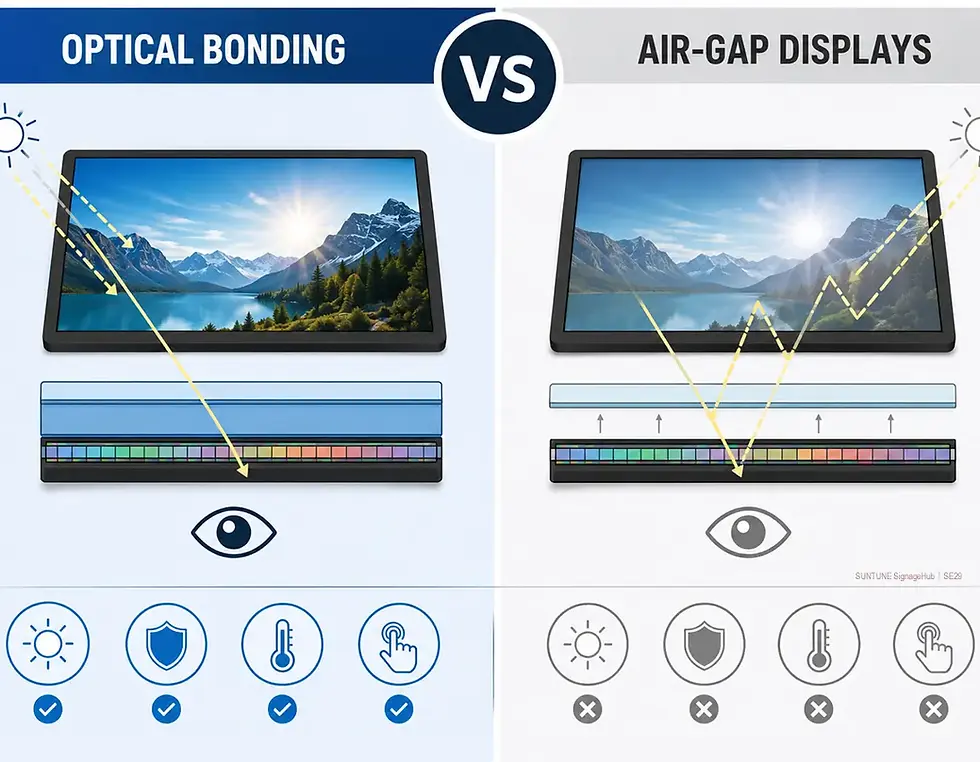
Outdoor LCD systems use advanced optical technologies that indoor screens typically do not include.
These include:
Anti-reflective glass
Optical bonding
High-contrast panel tuning
These technologies significantly improve sunlight readability, reduce glare, and maintain image clarity even under direct sunlight.
High-brightness indoor screens may increase luminance, but without optical enhancements, they still suffer from reflection and washed-out visuals.
Lifespan and Reliability Differences
The operational lifespan of a display is heavily influenced by its design environment.
Outdoor LCD systems are engineered for:
24/7 operation in extreme conditions
This includes thermal cycling, UV exposure, and continuous brightness operation.
Indoor screens used outdoors typically experience:
Accelerated backlight degradation
Thermal stress damage
Power system instability
Reduced overall lifespan
This leads to higher maintenance costs and frequent replacements.
Cost Consideration: Short-Term vs Long-Term
At first, high-brightness indoor screens may seem more cost-effective.
However, when evaluating total cost of ownership, the difference becomes clear.
Outdoor LCD systems offer:
Lower failure rates
Reduced maintenance
Longer operational life
Stable performance
Indoor screens used outdoors often incur hidden costs due to:
Repairs
Replacements
Downtime
Performance loss
In long-term deployments, outdoor LCD systems are significantly more cost-efficient.
Use Case Suitability Matters
The decision between outdoor lcd vs high brightness indoor screens depends heavily on application type.
Outdoor LCD systems are ideal for:
Smart city displays
Transportation hubs
Outdoor kiosks
Digital billboards
Retail storefront signage
High-brightness indoor screens may only be suitable for:
Semi-outdoor shaded environments
Temporary installations
Controlled outdoor enclosures
Understanding the application environment is essential for system selection.
Engineering Integration and System Stability
Outdoor LCD systems are not just displays—they are integrated engineering platforms.
They include:
Power regulation systems
Thermal control modules
Environmental sensors
Remote monitoring capabilities
This system-level design ensures consistent operation under varying conditions.
High-brightness indoor screens lack this integrated engineering foundation.
Industry Direction: Purpose-Built Outdoor Displays
The industry is increasingly shifting toward purpose-built outdoor LCD solutions rather than adapting indoor technology.
This trend reflects growing demand for:
Higher reliability
Smarter energy use
Better thermal performance
Improved visibility in real environments
Companies such as SUNTUNE focus on designing dedicated outdoor LCD systems that meet these engineering demands without compromise.
Selecting the Right Display Technology
As outdoor digital signage continues to expand across retail, transportation, and smart city infrastructure, the distinction between indoor and outdoor display technology becomes increasingly important.
The comparison of outdoor lcd vs high brightness indoor screens clearly shows that true outdoor performance requires more than brightness—it requires complete system engineering.
Future deployments will increasingly prioritize durability, thermal intelligence, and optical performance over raw luminance alone.
Organizations that choose purpose-built outdoor LCD systems will benefit from stronger reliability, lower lifecycle cost, and more consistent real-world performance.
Need Help Choosing the Right Outdoor Display Solution?
Selecting the right display technology is critical for long-term performance and cost efficiency. Whether you're planning outdoor advertising, smart city infrastructure, or retail digital signage, the right engineering approach makes all the difference.
Contact our team today to explore outdoor LCD solutions designed for real environmental conditions, superior durability, and long-term operational stability. Let us help you build a display system that performs reliably in the real world—not just on paper.


Comments