
Reflective LCD vs High-Brightness Outdoor LCD: Which Display Technology Is Better for Outdoor Applications?

As outdoor digital communication continues expanding across retail, transportation, smart cities, and public infrastructure, choosing the right display technology has become increasingly important. Two technologies frequently discussed in sunlight-readable applications are reflective LCD vs high brightness outdoor LCD. Both are designed to improve visibility outdoors, yet they operate on fundamentally different principles and are optimized for different use cases.
Understanding the strengths and limitations of each technology can help project developers, system integrators, and business owners make better investment decisions when deploying outdoor displays.
Understanding Reflective LCD Technology
Reflective LCD technology relies primarily on ambient light rather than an internal backlight. A reflective layer positioned behind the liquid crystal panel redirects incoming light back toward the viewer, allowing content to remain visible under bright environmental conditions.
Unlike conventional LCDs that require powerful backlighting, reflective LCDs become more visible as surrounding light levels increase. This unique characteristic makes them highly attractive for energy-conscious applications where direct sunlight is abundant.
Because reflective LCDs consume significantly less power, they are often used in battery-operated devices, industrial instruments, outdoor information systems, electronic shelf labels, and specialized smart city infrastructure. Their low energy requirements make them particularly suitable for installations where power availability is limited or sustainability goals are a priority.
However, reflective LCDs face challenges when displaying rich multimedia content. Color reproduction is generally less vibrant than traditional LCD technology, and visibility can decrease substantially in low-light or nighttime environments unless supplemental lighting is provided.
Understanding High-Brightness Outdoor LCD Technology
High brightness outdoor LCD displays follow a different approach. Rather than relying on ambient light, they utilize powerful backlighting systems that generate enough luminance to overcome direct sunlight.
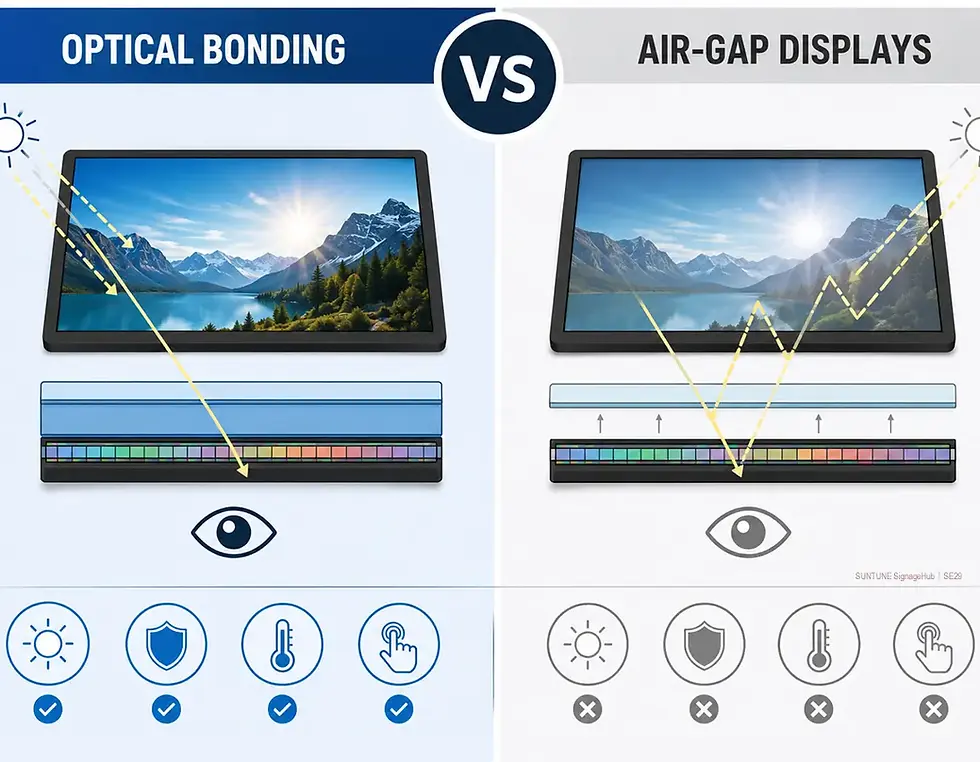
Modern outdoor LCD displays commonly operate between 1,500 and 4,000 nits or higher, depending on installation requirements. Combined with anti-reflective glass, optical bonding, and intelligent brightness controls, these displays maintain excellent visibility in virtually all lighting conditions.
High brightness outdoor LCDs are designed to support dynamic advertising, full-motion video, interactive applications, and real-time content management. They are widely used in retail storefronts, transportation hubs, outdoor kiosks, drive-thru systems, smart city displays, and digital advertising networks.
Their ability to deliver vibrant colors, high contrast ratios, and 24/7 operation makes them the preferred solution for most commercial digital signage deployments.
Sunlight Readability Comparison
One of the primary reasons organizations consider both technologies is sunlight readability.
Reflective LCDs perform exceptionally well under direct sunlight because they utilize ambient light as part of their viewing mechanism. In bright outdoor environments, content can remain highly visible while consuming very little power.
High brightness outdoor LCDs achieve sunlight readability through powerful illumination systems and optical enhancements. While they require more energy, they provide consistent image quality regardless of changing lighting conditions.
For static information displays operating mainly during daylight hours, reflective LCDs can be highly effective. For advertising, video content, and customer-facing communications that must remain visible around the clock, high brightness outdoor LCDs offer greater flexibility and reliability.
Power Consumption and Energy Efficiency
Energy efficiency is one of the strongest advantages of reflective LCD technology.
Because reflective LCDs require little or no continuous backlighting, power consumption can be dramatically lower than traditional outdoor display solutions. This makes them attractive for solar-powered installations and sustainability-focused projects.
High brightness outdoor LCDs consume more energy due to their advanced backlighting systems and thermal management requirements. However, improvements in LED efficiency, automatic brightness adjustment, and intelligent power management continue reducing overall operating costs.
Organizations prioritizing maximum energy savings often find reflective LCDs appealing, while businesses prioritizing customer engagement and advertising effectiveness generally accept higher power consumption in exchange for superior visual performance.
Color Performance and Multimedia Capability
Color quality represents one of the biggest distinctions between the two technologies.
Reflective LCDs are optimized primarily for readability rather than rich visual experiences. While modern designs have improved significantly, they typically cannot match the color vibrancy and dynamic video performance of high brightness outdoor LCDs.
High brightness outdoor LCDs are specifically engineered to deliver vivid colors, sharp imagery, and smooth video playback. This capability is critical for retail advertising, digital menu boards, outdoor promotions, interactive kiosks, and branded customer experiences.
For applications where visual impact directly influences customer engagement, high brightness outdoor LCD technology remains the industry standard.
Daytime and Nighttime Operation
Outdoor display projects rarely operate only during daylight hours.
Reflective LCDs perform best when ambient light is available. As environmental lighting decreases, visibility may require additional illumination solutions, increasing system complexity.
High brightness outdoor LCDs maintain consistent performance throughout the day and night. Automatic brightness controls allow displays to adapt to changing environmental conditions while preserving image quality and energy efficiency.
For businesses requiring continuous operation, especially in transportation, retail, hospitality, and advertising environments, this flexibility often becomes a decisive advantage.
Best Applications for Reflective LCD
Reflective LCD technology excels in applications where low power consumption and sunlight readability are more important than multimedia performance.
Common examples include public information boards, transit schedules, outdoor industrial equipment, environmental monitoring systems, smart city information terminals, solar-powered displays, and electronic shelf labeling systems.
These environments often prioritize readability, operational efficiency, and long battery life over dynamic advertising content.
Best Applications for High-Brightness Outdoor LCD
High brightness outdoor LCD displays dominate applications where customer engagement, branding, and visual communication are critical.
Common deployments include retail storefront displays, outdoor advertising networks, drive-thru menu boards, transportation hubs, outdoor kiosks, hospitality venues, sports facilities, and public digital communication systems.
The ability to display full-color graphics, animations, video content, and real-time information makes these systems ideal for modern digital signage strategies.
Companies such as SUNTUNE continue advancing outdoor LCD technology through high brightness, weatherproof, and sunlight-readable display solutions designed for demanding commercial environments.
Which Technology Is Better for Outdoor Applications?
The answer depends entirely on project objectives.
If the primary goal is maximizing energy efficiency while displaying mostly static information in bright outdoor conditions, reflective LCD technology can be an excellent choice.
If the objective is delivering engaging visual experiences, supporting dynamic multimedia content, maintaining visibility day and night, and generating stronger customer interaction, high brightness outdoor LCD technology remains the more versatile solution.
As display technologies continue evolving, both reflective LCD and high brightness outdoor LCD systems will play important roles across different segments of the outdoor display market. Understanding their unique strengths allows organizations to select the technology that best aligns with operational goals, user expectations, and long-term project requirements.
Looking for the Right Outdoor Display Technology?
Whether you're evaluating reflective LCD solutions for energy-efficient information systems or high brightness outdoor LCD displays for digital signage and advertising, selecting the right technology is critical to project success.
Contact our team today to discuss your application requirements. We can help you identify the ideal outdoor display solution based on visibility needs, environmental conditions, energy goals, and long-term performance expectations.


Comments