
Wall Mounted vs Totem Outdoor Digital Signage Displays: Choosing the Right Architecture for DOOH Performance

In modern digital-out-of-home (DOOH) infrastructure, display performance is no longer defined only by brightness or resolution. The mechanical architecture—how the display is physically deployed—directly determines reliability, serviceability, and long-term ROI.
Among the most widely used configurations are wall mounted systems and freestanding totem outdoor digital signage displays. While both support high-brightness LCD technologies and intelligent content delivery, their engineering logic and deployment scenarios differ significantly.
Understanding this distinction is critical for system integrators, advertising operators, and infrastructure developers who are planning large-scale deployments in transportation hubs, retail environments, and smart city networks.
Structural Philosophy: Integration vs Independence
The fundamental difference between wall mounted and totem systems lies in how they interact with their environment.
Wall mounted outdoor displays are designed as integrated components of existing architecture. They rely on building surfaces for structural support and are typically installed on façades, station walls, or retail exteriors. This approach minimizes footprint and blends the display into the surrounding environment.
Totem outdoor digital signage displays, on the other hand, are fully self-contained structures. They are engineered as independent enclosures with internal support frames, sealed cabinets, and reinforced bases. This allows deployment in open spaces such as plazas, sidewalks, transit platforms, and commercial entrances.
In engineering terms, wall-mounted systems prioritize integration efficiency, while totem systems prioritize deployment autonomy.
Environmental Resistance and Thermal Behavior
Outdoor digital signage must withstand UV exposure, rain, dust, and temperature fluctuations. However, the thermal behavior of wall-mounted and totem systems differs due to airflow and enclosure geometry.
Wall-mounted displays benefit from direct building adjacency, which can sometimes assist passive heat dissipation depending on installation conditions. However, they may also face heat accumulation if mounted on sun-exposed façades without sufficient ventilation clearance.
Totem systems are fully enclosed and exposed on all sides. This requires more advanced thermal management strategies such as internal airflow channels, heat sinks, or active cooling systems. Their advantage lies in predictable environmental isolation, making them suitable for harsh or variable outdoor conditions.
In high-brightness applications (2500–3000 nits and above), thermal stability becomes a decisive engineering factor.
Installation Complexity and Structural Requirements
Wall-mounted displays require structural verification of the installation surface. Load-bearing capacity, anchoring depth, and façade material must be evaluated before deployment. This often reduces installation cost but increases dependency on building conditions.
Totem displays require foundation engineering, including ground anchoring or embedded base plates. While installation is more complex and capital-intensive, it provides long-term stability and scalability in open environments.
From a project execution perspective, wall-mounted systems are faster to deploy in existing buildings, while totem systems are more suitable for greenfield infrastructure projects.
Maintenance and Service Accessibility
Serviceability is a key factor often underestimated during system design.
Wall-mounted displays can be more difficult to access depending on installation height and surrounding architecture. Maintenance often requires lifting equipment or façade access planning.
Totem displays are designed with front or rear service doors, modular internal components, and standardized enclosure layouts. This allows technicians to perform repairs, module replacement, and diagnostics with minimal disruption.
In large-scale networks, service efficiency directly impacts operational cost over time, making maintenance design a critical decision factor.
Application Scenarios and Deployment Logic
Wall-mounted outdoor displays are commonly used in:
Retail storefront advertising
Building façade branding
Transport station interior corridors
Space-constrained urban environments
Totem outdoor digital signage displays are preferred in:
Transportation hubs (airports, metro stations, bus terminals)
Smart city wayfinding systems
Outdoor advertising networks (DOOH)
Commercial plazas and pedestrian zones
Each system aligns with different infrastructure strategies rather than competing directly.
Economic Considerations and Lifecycle Value
Initial investment for wall-mounted systems is typically lower due to reduced structural requirements. However, long-term ROI depends heavily on environmental exposure and maintenance accessibility.
Totem systems require higher upfront investment but often deliver more stable lifecycle performance in uncontrolled outdoor environments.
The true decision metric is not cost alone, but lifecycle efficiency—balancing installation, uptime, maintenance cycles, and environmental resilience.
This is where ESSENCE becomes critical: the real value of outdoor signage lies not in its form factor, but in how consistently it delivers visual communication under real-world conditions.
Technology Convergence: Why the Gap Is Narrowing
Modern outdoor LCD engineering is gradually reducing the gap between wall-mounted and totem systems. Advances in:
IP65/IP66 sealing technology
Smart thermal control systems
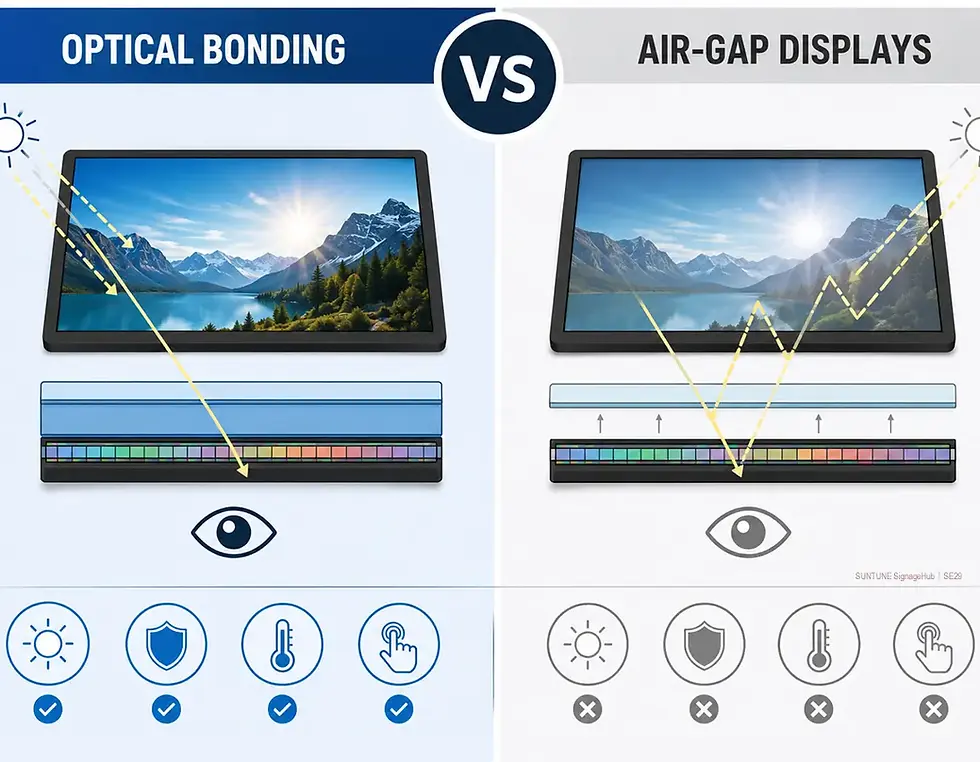
Anti-glare and optical bonding
Remote monitoring and diagnostics
…are allowing both architectures to achieve higher reliability standards than ever before.
However, physical deployment logic still defines their optimal use cases.
Deployment Outlook
As smart cities and DOOH ecosystems evolve, hybrid deployment strategies are becoming more common. Developers increasingly combine wall-mounted displays for dense urban architecture with totem systems for open-area communication nodes.
Between wall mounted vs totem outdoor digital signage displays, future networks will likely focus less on form factor competition and more on system interoperability, energy efficiency, and adaptive content distribution.
The long-term direction is clear: outdoor digital signage is evolving from isolated displays into integrated communication infrastructure.
If you are planning a DOOH project, infrastructure upgrade, or distributor partnership, selecting the right display architecture is critical for long-term performance and cost efficiency.
SUNTUNE SignageHub specializes in high-brightness outdoor LCD systems, including wall-mounted enclosures and industrial-grade totem kiosk solutions designed for extreme environments.
👉 Contact us to discuss your project requirements, technical specifications, or OEM/ODM customization needs.
Let’s build a reliable, scalable outdoor digital signage network tailored to your market.


Comments